
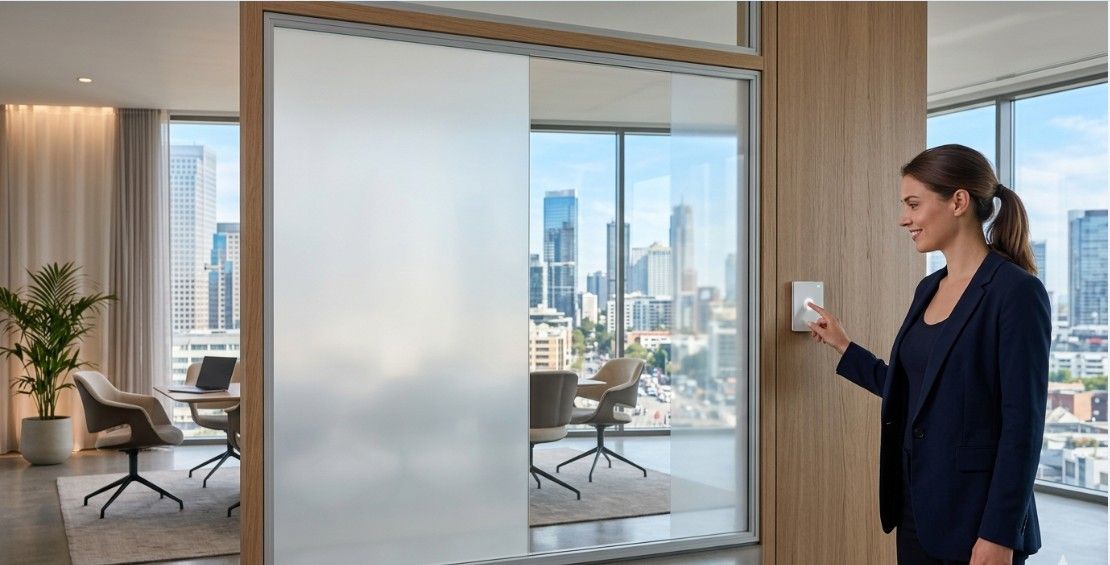
Smart film is an advanced technology that transforms ordinary glass surfaces into dynamic, switchable panels capable of changing transparency on demand. This innovation has emerged as a practical solution for privacy, light control, energy efficiency, and modern architectural design.
With roots in materials science and electrical engineering, smart film is reshaping how spaces are designed and experienced across residential, commercial, healthcare, and industrial environments.
Smart film, often referred to as PDLC film, switchable film, or privacy film, is a thin layer of material applied to existing glass surfaces. Unlike traditional static glass or window treatments such as curtains and blinds, smart film can electronically change its optical properties. When activated, it becomes transparent, allowing clear visibility and light passage. When deactivated, it turns opaque or frosted, providing instant privacy without physical barriers.
Smart film represents a retrofit-friendly alternative to fully integrated smart glass. While smart glass typically incorporates switchable technology during manufacturing, smart film solutions are designed to be applied onto existing glass, making them cost-effective and flexible for upgrades in existing buildings.
The vast majority of smart film products use Polymer Dispersed Liquid Crystal (PDLC) technology. PDLC film consists of microscopic liquid crystal droplets suspended within a polymer matrix. This composite layer is sandwiched between two transparent conductive films that apply an electrical field when powered.
Smart film operates based on the behavior of liquid crystal molecules:
This transition can occur in milliseconds, offering near-instant changes between states.
While PDLC is dominant in smart film products, there are other switchable technologies used in adjacent domains:
These alternatives are less common in self-adhesive smart film applications but are important in understanding the broader smart glazing ecosystem.
Smart film requires a low-voltage electrical supply, typically delivered through discreet wiring connected to a transformer or power controller. The system can be controlled through various interfaces including:
Once connected and programmed, the film responds to commands by applying or removing current to transition between transparent and opaque states.
When transparent, smart film allows natural light to permeate interiors with minimal alteration to visibility. When opaque, it diffuses light, creating privacy while still admitting ambient brightness. The opaque state does not typically offer complete blackout like heavy curtains, but it is sufficient to obscure detailed images and protect privacy.
Smart film’s versatility has enabled its adoption across a wide range of sectors:
Smart film is increasingly used in offices and corporate facilities to transform glass partitions, conference rooms, and boardrooms. It enables privacy during meetings and opens up to maintain visual connectivity and natural light when required.
This adaptability supports modern open office designs while addressing confidentiality and space optimization needs.
In homes, smart film can be applied to patio doors, bathroom windows, and other glass surfaces to provide privacy without traditional window coverings. Its sleek aesthetic aligns with contemporary interior design trends.
Healthcare settings often require flexible privacy solutions for consultation rooms, patient areas, and diagnostic spaces. Smart film allows rapid shifts between open visibility and secure, private environments without structural changes.
In retail storefronts, smart film can shift window displays between transparent showrooms and opaque promotional spaces. Hotels and hospitality spaces use smart film in suites, bathrooms, and meeting areas for enhanced guest experience and dynamic aesthetics.
Smart film offers a range of functional and design advantages:
Users can immediately switch between transparent and opaque states at the touch of a button, eliminating the need for blinds or curtains.
Smart film modulates light without fully blocking it, balancing the need for daylight with privacy and glare management.
Many smart film products also block significant portions of harmful UV rays, reducing interior fading and potentially lowering cooling costs by reducing solar heat gain.
By replacing traditional window treatments with virtually invisible technology, smart film contributes to a clean, unobstructed visual aesthetic. This is particularly valuable in minimalist and contemporary design contexts.
While smart film provides significant advantages, there are practical factors to consider:
PDLC film in transparent mode may have a slightly hazy or milky appearance compared with untreated glass or alternative technologies such as SPD.
Smart film typically requires continuous power to maintain its transparent mode, which may influence operational costs and system design.
The final appearance and performance of smart film depend on the quality of the base glass and professional installation, highlighting the importance of skilled application.
Smart film is part of a growing trend toward interactive building materials that enhance sustainability, efficiency, and user experience. Architects, engineers, and designers increasingly specify smart film in projects focused on adaptive environments and intelligent automation.
Advances in materials science and integration with IoT (Internet of Things) platforms will likely drive new features, including automated lighting schedules, occupancy-based privacy control, and enhanced energy management. While still evolving, smart film technology represents a significant step in the broader shift toward adaptive infrastructure.
This blog covers what smart film is, how it works, its PDLC technology, practical applications in homes, offices, and healthcare, benefits, limitations, and future trends in smart glass solutions.
Smart film is a switchable privacy film that changes from transparent to opaque using electrical current, controlling light transmission and visibility.
Yes, smart film is designed to be retrofitted onto existing glass doors, windows, and partitions without needing to replace the whole panel.
Yes, most PDLC smart films need a low-voltage electrical supply to remain transparent; when power is off, they turn opaque.
Smart film works well in residential and commercial spaces for privacy control, modern design, and flexible light management.
Smart film is a cutting-edge solution that transforms ordinary glass into dynamic, switchable panels, offering instant privacy, light control, and modern aesthetics. Its versatility makes it ideal for residential, commercial, healthcare, and hospitality applications, providing both functional and design advantages.
For expert guidance on selecting, installing, or maintaining smart film and switchable glass solutions across the UAE, Murtaza Glass & Frames provides professional advice, premium products, and skilled installation to ensure every project meets the highest standards of quality and design.
Contact our specialists to ensure expert installation, precise retrofitting, and long‑lasting performance.
Discover professional guides on glass solutions, from doors and partitions to balustrades and windows, helping you choose the perfect style for your home or business.

September 8, 2026
September 1, 2026
August 25, 2026

August 18, 2026
August 11, 2026
 +971 58 543 0631
