
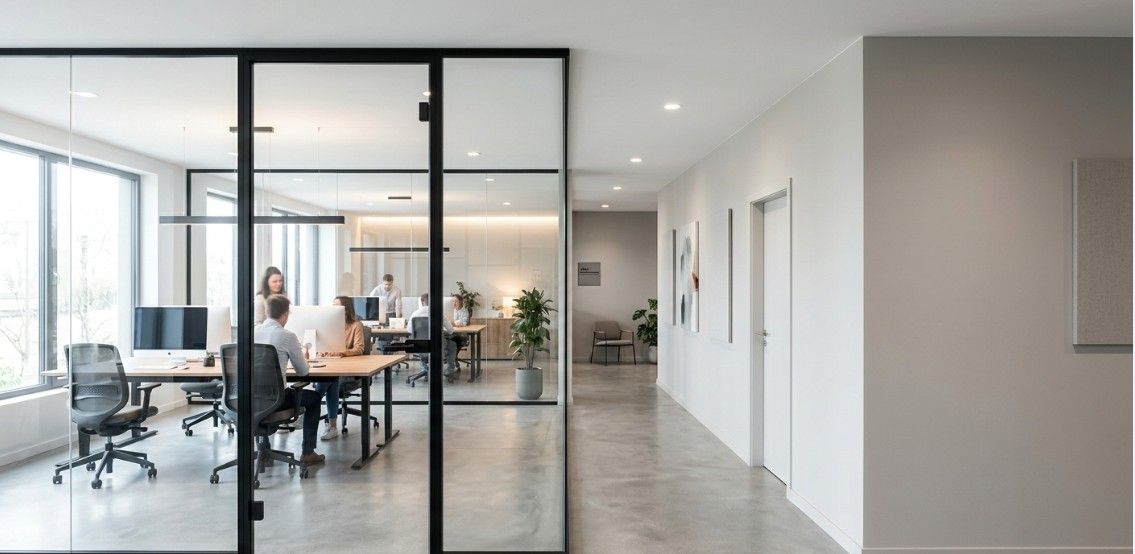
Office interior design plays a major role in productivity, employee comfort, and brand perception. One of the most important decisions in workspace planning is choosing between glass partitions and drywall systems. Both solutions are widely used in modern commercial environments, but they serve different purposes.
Glass partitions focus on openness, natural light, and modern aesthetics, while drywall is preferred for privacy, acoustic control, and cost efficiency. This article focuses on providing a clear, research based comparison of both systems using real world performance factors, cost insights, and practical workplace use cases.
Glass partitions are non load bearing walls made from tempered or laminated glass panels supported by aluminum or steel framing systems. They are widely used in open plan offices to divide space without blocking visibility or natural light.
For businesses looking to implement modern office layouts, professionally designed glass partitions solutions help achieve both functionality and premium aesthetics in commercial interiors.
Drywall partitions, also known as gypsum board walls, are constructed using a metal or timber frame covered with plasterboard sheets. These are then finished with paint, wallpaper, or other surface treatments.
Drywall is the traditional standard in office construction and remains widely used for private rooms and permanent layouts.
Office interiors strongly influence brand perception and employee experience. The choice between glass and drywall changes how open or closed a workspace feels.
Lighting quality affects productivity, mood, and energy efficiency in workplaces. Glass and drywall handle natural light in completely different ways.
Sound control is essential for meetings, confidential work, and focused tasks. Drywall and glass differ greatly in acoustic performance.
Modern workplaces often need flexible layouts to adapt to growth and change. Partition systems play a key role in space adaptability.
For offices that want enhanced movement and space efficiency, systems like slim sliding doors can further improve accessibility while maintaining a clean modern design flow.
Cost is a major factor in office construction planning. Glass and drywall differ in both upfront and long term financial impact.
Long term durability affects maintenance costs and visual quality over time. Both materials perform differently under daily use.
| Feature | Glass Partitions | Drywall Partitions |
|---|---|---|
| Aesthetics | Modern, premium, open look | Traditional, solid, enclosed design |
| Natural Light | Excellent light flow | Blocks natural light |
| Privacy | Moderate privacy | High privacy and sound control |
| Flexibility | Easy to reconfigure | Permanent, hard to modify |
| Cost | Higher initial cost | More budget friendly |
| Durability | High durability, low maintenance | Strong but prone to damage over time |
A software company using an open plan layout installed glass partitions for meeting rooms and collaborative spaces. This resulted in a 30 to 40 percent improvement in perceived openness, better visibility between teams, and stronger collaboration.
However, it also introduced a slight increase in ambient noise, which was balanced by improved team engagement and interaction.
A law firm implemented drywall partitions for private offices and meeting rooms to prioritize confidentiality.
This setup ensured strong privacy compliance, significantly reduced sound leakage between departments, and helped lower overall construction costs compared to glass partition systems, making it more suitable for secure legal operations.
Choosing between glass and drywall depends on office goals such as collaboration, privacy, budget, and flexibility. Below is a clear guide to help decide the right option for different workplace needs. Based on office design research and industry practice:
Glass is ideal for modern workplaces where openness, light, and collaboration matter most.
Drywall is better for privacy focused and cost sensitive office spaces.
For high end office environments that require seamless space division and aesthetic movement solutions, designer folding doors with slim sliding systems offer an advanced architectural upgrade for modern interiors.
Glass partitions vs drywall comparison for offices covering design, cost, privacy, light, flexibility and use cases. Helps choose the best partition system for modern workplaces.
The best material depends on office needs such as privacy, budget, and design goals. Glass is ideal for modern and open offices, while drywall is better for privacy and sound control.
No, glass walls are generally more expensive than drywall due to material quality and installation requirements. Drywall is a more budget friendly option for basic office construction.
Glass partitions offer natural light, modern aesthetics, and flexibility but have limited sound insulation. They are less private compared to drywall and usually cost more.
Offices use glass walls to create open, bright, and collaborative environments. They improve visibility, enhance workspace design, and support a modern corporate image.
Glass partitions and drywall both offer strong benefits depending on office requirements. Glass is best for modern, bright, and flexible workspaces, while drywall is more suitable for privacy focused and budget conscious office environments where sound control and permanence are important.
Create a workspace that balances functionality, style, and efficiency with the right partition system for your business needs.
With expert craftsmanship and customized interior solutions, Murtaza Glass & Frames delivers high quality glass partition and drywall installations designed to match modern architectural standards while ensuring durability for every office project across Dubai and the UAE.
Discover professional guides on glass solutions, from doors and partitions to balustrades and windows, helping you choose the perfect style for your home or business.

October 22, 2026

October 14, 2026

October 12, 2026
September 30, 2026
September 24, 2026
 +971 58 543 0631
