
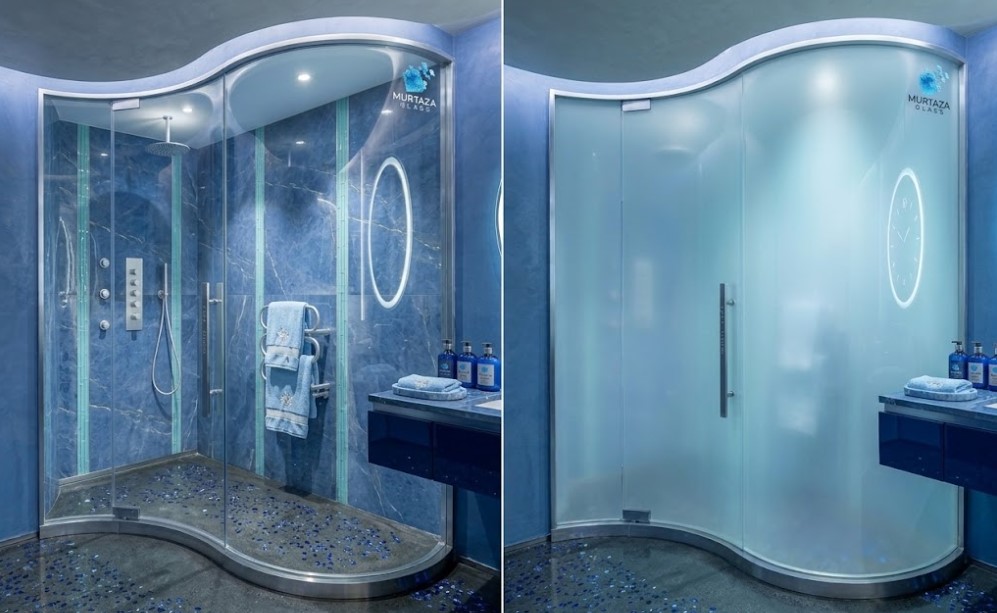
Glass walls defined the modern open-plan office. They also created a problem: every meeting room became a fishbowl, and every south-facing window became a heat source. Facilities teams answered with blinds, frosted vinyl, and expensive glass replacements.
Smart glass film offers a third route. It converts existing glazing into switchable privacy glass without construction, which is why interest in retrofit workplace upgrades keeps rising.
Smart glass film is a thin, switchable layer applied to existing glass that changes from clear to opaque when voltage is applied. It uses polymer dispersed liquid crystal (PDLC) technology to align or scatter light, giving you privacy on demand without replacing the window.
Inside the film, liquid crystal droplets sit between two transparent conductive layers. When a low-voltage AC driver powers the film, the droplets align and light passes through. When power is off, the droplets scatter light and the surface turns milky white.
That default state matters for planning. A PDLC film is opaque without power, so a power cut makes every treated room private. Electrochromic glass behaves differently, tinting slowly rather than scattering light.

The main benefits are instant privacy on demand, lower cooling costs, glare control, and flexible space design. Smart glass film also blocks most ultraviolet radiation and can replace blinds, which cuts cleaning and maintenance costs for facilities teams across the building.
The benefits fall into five groups:
Smart glass film turns a glass wall opaque within a second when you flip a switch or trigger a sensor. That gives meeting rooms, HR offices, and executive suites visual privacy without curtains, while keeping the space transparent during open hours.
It also supports confidentiality practices. Boardrooms, legal teams, and finance departments can screen sensitive whiteboards and screens from the corridor. Note that the film provides visual privacy only. It does not improve sound insulation.
Smart glass film can reduce cooling costs by limiting solar heat gain, but the result depends on the film type and the glass orientation. Many products block most ultraviolet light and part of the infrared heat, which lowers peak air-conditioning load on sun-facing windows.
Be realistic here. A standard switchable layer is not a dedicated solar control film. Compare the solar heat gain coefficient (SHGC) and U-factor ratings that the National Fenestration Rating Council uses to certify window performance, then model the savings for each facade.
Smart glass film lets teams convert one room into open, private, or projection-ready space without construction. Because it bonds to existing glazing, facilities teams can retrofit partitions, reconfigure floors, and avoid the demolition costs of installing new switchable glass panels or partitions.
Some PDLC films also work as rear-projection surfaces in the opaque state. A single glass wall can then serve as a privacy barrier, a presentation screen, and a window.

Planning an office upgrade with smart glass film?
Explore our smart glass film options for offices, meeting rooms, and glass partitions. Contact our team to discuss your requirements and find the right solution for your space.
Check glass compatibility, power and control integration, installation quality, and cybersecurity before you buy. Film works best on flat, clean, single-pane or laminated glass, and its controller must connect safely to your existing building network without creating a new attack surface.
Use this pre-installation checklist:
Secure smart glass controllers by treating them as network-connected IoT devices. Segment them from corporate systems, enforce role-based access control, rotate credentials, and keep firmware patched. These steps follow zero-trust architecture principles and limit what a compromised controller can reach.
NIST publishes baseline guidance for IoT device security. Add audit logging and automated failure alerts so a stuck or tampered panel triggers a ticket instead of an unnoticed privacy gap.

Smart glass film costs more than frosted or blind-based privacy, but less than replacing glass with factory switchable panels. Pricing depends on glass area, film grade, power hardware, and control integration, so request a per-square-foot quote after a site survey.
Compare total cost of ownership, not purchase price alone. Blinds need cleaning and replacement. Frosted film cannot switch. Film needs power and a managed controller. Include energy savings, maintenance labor, and the cost of reconfiguring rooms in your model.
If you want film controlled by schedules, sensors, or a central system, plan that integration before installation. It keeps the glazing working as part of the workplace rather than as a standalone gadget.
Smart glass film is worth it for offices that need flexible privacy, daylight, and a modern layout, and less so for rooms that rarely change use. Treat it as a controlled building system, not a decoration, and weigh the energy, security, and maintenance tradeoffs before you commit.
If your floors change often, your meeting rooms host sensitive work, or your facade faces strong sun, smart glass film is a practical upgrade. If a room stays private all day, simple frosted film is cheaper and carries no power or security overhead.
Start with a survey of your glazing, a clear control and security plan, and a realistic cost model. A short pilot in one meeting room will show you more than any brochure.
Ready to plan your smart glass film installation?
Share your glass area and room layout with our team. We will review suitable film options, power layout, and installation requirements to help you plan your project. Contact Murtaza Glass to arrange a site survey and discuss your needs.
Many manufacturers rate PDLC smart glass film for roughly 10 years or more of normal office use. Actual lifespan depends on film quality, edge sealing, humidity, and installation. Always confirm the warranty period and what it covers before purchase.
Yes, in most cases. Smart glass film bonds to existing flat glass, including many laminated and single-pane units. Curved, cracked, or certain tempered and double-glazed panels may not qualify, so request a glass assessment from the installer first.
No. PDLC film draws low power, typically a few watts per square meter while switched on. Total consumption is small compared with lighting or air conditioning, though driver efficiency and the number of panels will affect the final figure.
October 22, 2026

October 14, 2026

October 12, 2026
September 30, 2026
September 24, 2026
 +971 58 543 0631

