
Custom glass furniture in Dubai has moved from showpiece to specification. Penthouse owners, interior designers and hospitality fit-out teams now ask for tables, shelves and showcases cut to the millimetre, rather than adapting catalogue pieces to awkward rooms.
Specifying glass is an engineering decision as much as a design one. Thickness, edge profile, glass type and base material decide whether a piece looks effortless or fails inspection. This guide follows the order in which a project team meets those decisions.
Murtaza Glass fabricates in Sharjah and delivers custom glass furniture in Dubai and across the UAE. The sections below combine design direction with fabrication detail, so you can brief a workshop with confidence.
Custom glass furniture in Dubai is in demand because it solves problems that catalogue pieces cannot, fitting irregular layouts and keeping sightlines open in compact penthouses. Designers also use it to match the marble, brass and timber already specified in the scheme, since each piece is sized and finished for one room.
Dubai interiors lean on dense materials such as book-matched marble, veined stone, bronzed metal and lacquered joinery. Custom glass furniture in Dubai balances that weight. A transparent top lets the base, the flooring and the light carry the composition.
Open-plan villas and high-floor apartments add a second driver. Floor-to-ceiling glazing floods rooms with hard daylight, so a clear surface reads lighter than a solid one. Low-iron or tinted glass then tunes how that light behaves across the table.
Commercial buyers of custom glass furniture in Dubai have different reasons. Showrooms use glass to present products without visual clutter, and executive offices use it to signal precision. Hospitality brands commission bespoke tables to give each venue a recognisable signature.
The common thread is control. Made-to-order glass furniture in Dubai lets the designer fix the span, thickness, edge and finish before anything is cut. Off-the-shelf furniture forces compromises on every one of those variables.
Murtaza Glass makes dining and coffee table tops, console and side tables, floating and display shelves, TV units, reception counters, desks and table covers for existing furniture. Each piece is cut to your drawing, in rectangles, rounds, ovals or custom shapes, and finished in the glass and edge you specify.
The full range is listed on the custom glass furniture in Dubai service page. The categories below explain how each one is engineered, and which materials suit it.
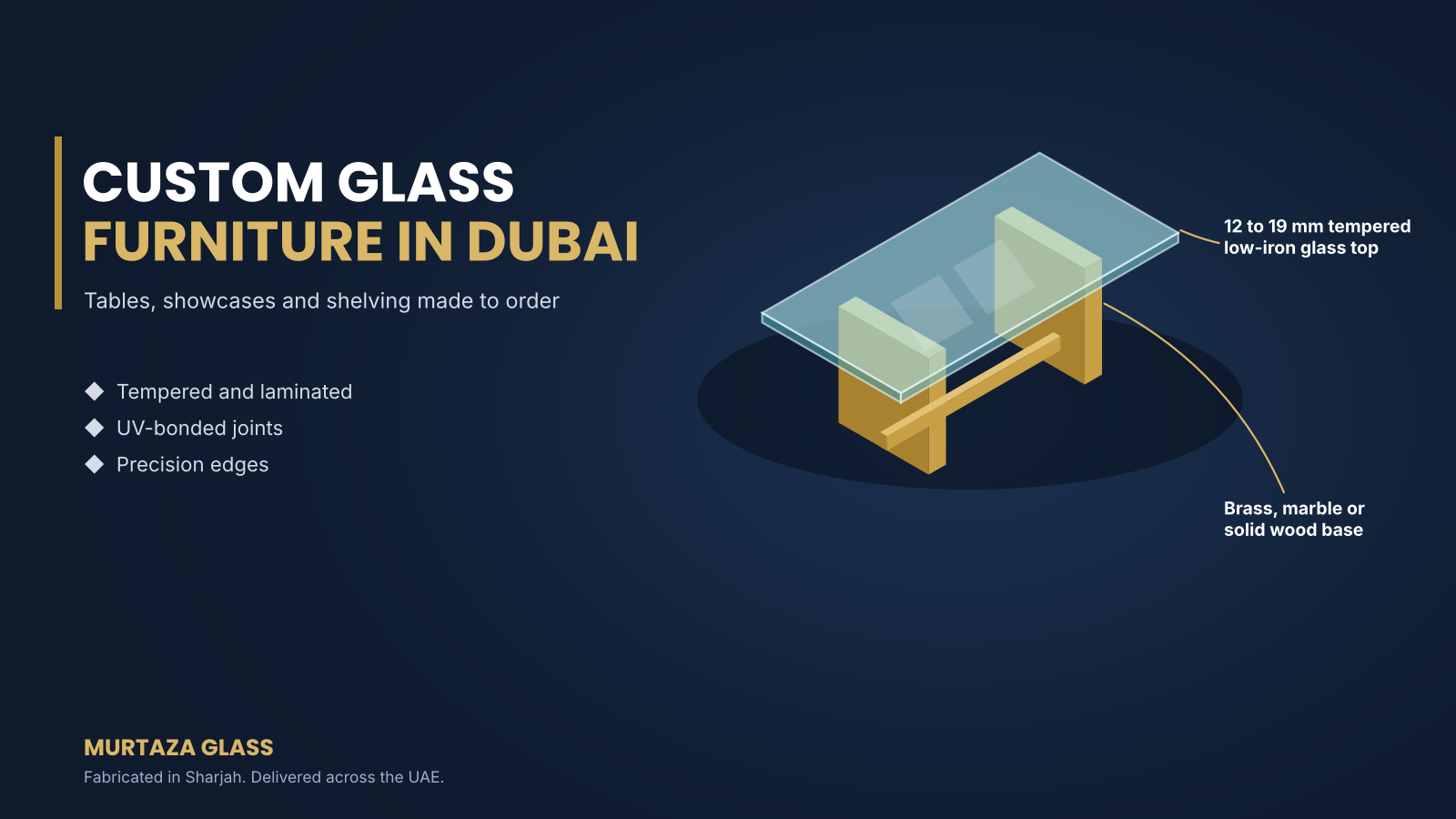
A bespoke glass dining table in Dubai pairs a heavy structural top, usually 12mm to 19mm thick, with a base engineered for that exact span. The base can be marble, brass, brushed steel or solid wood, and overhang, seat spacing and support positions are calculated before any glass is cut.
Base choice drives visual weight. A single marble pedestal makes the top appear to hover, while twin brass trestles give a more architectural line. Solid wood bases add warmth and suit villas with timber joinery.
Support geometry matters more than most briefs admit. Glass should overhang its supports by a controlled distance, and seats should avoid the unsupported mid-span. Silicone or rubber pads isolate the glass from metal and stone.

Weight shapes every custom glass furniture in Dubai project. A 2,400 x 1,100 mm top in 12mm glass weighs roughly 79 kg. In 19mm it passes 125 kg, which affects lift access, base rating and floor loading in upper-storey rooms.
Executive conference tables use 15mm to 19mm tempered or laminated glass over heavy bases, often with cut-outs for power and data modules. Laminated build-ups keep fragments bonded if a pane is damaged, while long tables rely on several supports to control deflection and handling risk.
Cable cut-outs, grommet holes and notches must be drilled or cut before toughening. Changing them later means replacing the pane. Confirm the power module and cable routes with the AV consultant before approving the drawing for any office with custom glass furniture in Dubai.
Custom glass coffee tables in the UAE work best when the glass top is the visible hero and the support stays visually quiet. Floating tops on slim metal frames, two-tier designs and nesting side tables all suit luxury living rooms. A thickness of 10mm to 12mm handles typical spans.
Multi-tiered shelving adds display space without blocking sightlines. Smoked grey or bronze lower tiers hide clutter, while a clear upper tier keeps the form light. Round and oval tops soften rooms dominated by straight joinery lines, a useful trick when custom glass furniture in Dubai villas sits beside marble joinery.
Edges matter on small pieces because they are touched and seen at close range. A flat polish suits minimal schemes. An ogee or bevel adds a jewellery-like detail to accent tables.
UV-bonded glass furniture joins mitred glass edges with a light-cured adhesive, leaving a nearly invisible joint with no screws or brackets. That clarity suits showcases for watches, collectibles and retail products, because the joint removes the metal frames that would otherwise distract from the display.
Murtaza Glass also offers glass display boxes for retail and collectors who want the same clean finish. Showcases that carry shelf loads should be engineered, not judged by eye.
Glass shelves, console tables and vanity tops work best where light must travel and surfaces must stay easy to clean. Wall-mounted shelves suit alcoves and display walls, freestanding consoles suit entrance halls, and glass vanity tops suit bathrooms, with each thickness matched to its load.
Bathroom tops should use toughened glass with polished, sealed edges because of humidity and splash. For kitchens and utility surfaces, glass worktops follow the same principles of thickness and support.
Table 1. Furniture type, glass thickness and support for custom glass furniture in Dubai (indicative, confirmed by load check)
| Furniture type | Typical thickness | Typical base or support | Design note |
|---|---|---|---|
| Dining table | 12 to 19mm | Marble, brass, steel or timber | Calculate overhang and seat positions |
| Executive conference table | 15 to 19mm, laminated option | Multiple heavy bases | Cut-outs made before toughening |
| Coffee table | 10 to 12mm | Slim metal, stone or timber | Edge detail is closely visible |
| Side or accent table | 8 to 12mm | Metal frame or pedestal | Shorter spans allow thinner glass |
| UV-bonded showcase | 8 to 12mm per panel | Bonded glass with discreet base | Clean mitres, engineered shelf loads |
| Wall shelf | 8 to 10mm | Concealed brackets | Fixings into a verified substrate |
| Console or vanity top | 10 to 12mm | Wall-mounted or leg supports | Polished, sealed edges in wet areas |
Most custom glass furniture uses toughened glass between 8mm and 19mm thick, chosen by span, support layout and load. Coffee tables typically use 10mm to 12mm, dining tables 12mm to 15mm, and boardroom or slab designs 15mm to 19mm, always after a load check on the actual design.
Float glass weighs about 2.5 kg per square metre for every millimetre of thickness. That figure drives delivery planning, base selection and lift capacity as much as structural performance when custom glass furniture in Dubai goes into a tower.
Table 2. Glass thickness, weight and application for custom glass furniture in Dubai (indicative)
| Thickness | Weight per m2 | Typical application | Practical note |
|---|---|---|---|
| 8mm | 20 kg | Shelves, side tables, vanity tops | Short, well-supported spans |
| 10mm | 25 kg | Coffee tables, console tops | Refined edge profile |
| 12mm | 30 kg | Dining tables, desks | Common choice for bespoke tops |
| 15mm | 37.5 kg | Large dining tables, reception counters | Needs a rated base |
| 19mm | 47.5 kg | Boardroom tables, heavy slab pieces | Needs a lift and handling plan |

Load is not only weight. A person leaning on an edge or a dropped object creates a point load that is harsher than an evenly spread one. Hospitality and office pieces need a larger safety margin than a private living room.
Choose laminated glass when fragment retention matters, such as conference tables, hospitality tables or any surface used by many people. Tempered glass suits most private tabletops because it is strong and breaks into small granules, while laminated builds bond two panes with an interlayer, as described in ISO 12543-1, and hold fragments in place.
Tempered glass is produced to EN 12150-1, which covers tolerances, flatness, edgework and fragmentation behaviour. A rare nickel sulfide inclusion can still cause spontaneous breakage. Heat soaking under EN 14179-1 screens for it, so specify it for large, high-value tops in custom glass furniture in Dubai projects.
Yes, a tempered glass tabletop replacement in Dubai is possible when the base, fixings and original dimensions are measured accurately, because the new top is made to a precise template. Tempered glass cannot be cut or drilled after toughening, so share photos, measurements and the intended load before production starts.
Measure the base footprint, support positions and any recesses. Note chips or hairline cracks in the old top, since they hint at the failure cause. Edge impact and uneven support are common culprits.
A like-for-like swap can repeat the problem. Treat a replacement as the moment to upgrade thickness, add edge protection or move to laminated glass.
Low-iron Optiwhite glass suits luxury furniture when colour accuracy matters, because it removes the green tint of standard clear glass. Bronze or smoked grey tints add depth, frosted glass hides contents, mirror finishes add reflection, and fluted reed glass adds texture. Choose by light, base material and use.
For custom glass furniture in Dubai interiors, note that standard clear float shows a green tint at the edge, and the effect deepens with thickness. A 19mm slab can look distinctly green beside white marble. Low-iron glass keeps edges crisp and neutral.
Table 3. Glass type comparison for custom glass furniture in Dubai
| Glass type | Visual character | Best for | Consideration |
|---|---|---|---|
| Standard clear | Slight green edge tint | Economical tabletops | Tint grows with thickness |
| Low-iron (Optiwhite) | Ultra-clear, neutral | White marble, lacquer, showcases | Higher cost, best colour accuracy |
| Bronze tint | Warm, reduces glare | Dining tables with brass bases | Darker tops show less clutter |
| Smoked grey | Cool, contemporary | Coffee tables, lower tiers | Pairs with pale bases |
| Frosted | Soft, private | Shelves, TV units | Apply finish before toughening |
| Mirror or back-painted | Reflective or solid colour | Accent tables, shelf backs | Seal edges in humid areas |
| Fluted (reed) | Vertical texture | Cabinet fronts, console panels | Better for fronts than dining surfaces |
Tint and finish choices are covered in more detail on the reflective and tinted glass page. Request physical samples and judge them under the lighting of the actual room.
Next step. Unsure which glass, thickness or edge fits your design? Send your drawing, photos and dimensions on WhatsApp and the Murtaza Glass team will recommend a specification before you commit to a final drawing.
Flat polish suits minimalist pieces, pencil polish softens the edge for daily handling, a bevel adds light-catching detail, and an ogee delivers a classic decorative profile. Mitred edges at 45 degrees are used for UV-bonded joints, so pick the profile by who touches the piece and how closely it is seen.
Table 4. Edge profile comparison for custom glass furniture in Dubai
| Edge profile | Look | Best for | Note |
|---|---|---|---|
| Flat polish | Crisp, minimal | Contemporary dining tables, shelves | Arris is lightly eased for safety |
| Pencil polish | Soft, rounded | Coffee tables, desks | Comfortable to touch |
| Bevelled | Angled, light-refracting | Accent tables, mirrors | Bevel width set at order |
| Ogee | S-curve, classic | Traditional and neoclassical villas | Needs thick glass to show the curve |
| Mitred (45 degrees) | Sharp, near-invisible corner | UV-bonded showcases, box tables | Needs precision grinding |

Edgework shapes how custom glass furniture in Dubai looks up close. All of it must be complete before toughening. Once glass has been heat-treated, the profile cannot be changed. Approve edge samples before production starts.
UV bonding joins two polished glass surfaces with a liquid adhesive that cures under ultraviolet light, creating a clear, rigid joint with no mechanical fasteners. Mitred edges at 45 degrees give the cleanest corners, while butt joints suit shelves, and joint quality depends on flatness, cleanliness and cure control.
Limits are real. UV adhesives have rated temperature and load ranges, so a bond near strong sunlight or a heat source needs a suitable datasheet. Treat bonded joints as engineered details, not unlimited load paths.
Heat tempering protects glass furniture by raising its strength and making it break into small, blunt granules, while scratch-resistant nano-coatings add a thin layer that reduces micro-marking and makes cleaning easier. Neither makes glass indestructible, so felt pads, trivets and careful handling still matter for every piece.
Toughened glass also tolerates larger temperature differences than annealed glass. That helps near sun-facing glazing and air-conditioning vents. Request these points in writing when you order custom glass furniture in Dubai.
A complete brief for custom glass furniture in Dubai states the load, span, glass type, edge, base and access route, so a fabricator can calculate thickness, price and delivery before cutting begins. Missing any one of these six points is a frequent cause of redesign and delay.
Dubai towers and coastal climate affect glass furniture through lift limits, delivery rules and corrosion, because service lifts have fixed dimensions and humidity attacks unprotected metal and unsealed edges. Building management also controls delivery windows, so plan access and materials before the drawing is approved.
Many towers restrict when large panes can move through shared areas. Measure the lift door, the cabin and every corridor turn. A 3,000mm top may need a different route, or a split design.
For terrace, marina and waterfront pieces, choose corrosion-resistant metals such as 316 stainless steel or PVD-finished brass. Seal mirror and back-painted edges against moisture.
Fabrication starts with laser site measurement, then moves through load checks, CNC cutting, edge polishing, toughening, inspection, protected delivery and installation. Murtaza Glass fabricates in Sharjah and delivers across the UAE, and each step should produce a signed-off drawing or inspection record.

White-glove installation means the crew protects floors, handles glass with vacuum lifters, checks level and pad seating, and removes packaging. For large tops, the base is set and levelled before the glass arrives. Master craftsmen at Murtaza Glass inspect the finished piece with you under the room lighting.
To see what can be produced, review the custom glass furniture in Dubai service page. Share your drawing or photos with the team, and they will confirm thickness, edge and delivery.
Clean glass furniture with a soft microfibre cloth and a mild, non-abrasive glass cleaner, then dry the surface to avoid streaks. Avoid abrasive pads and harsh powders that scratch glass or damage coatings, wipe spills quickly, and lift objects instead of dragging them across the top.
Well-made custom glass furniture in Dubai homes needs little care, but a routine protects the finish. The checklist below keeps tops clear and joints sound.
A chipped edge or crack in toughened glass can fail without further warning, because the damage disturbs the surface stress. Replace it promptly. More practical guidance is collected in our glass fabrication insights.
Custom glass furniture in Dubai is the right choice when fit, finish and safety matter more than speed from a showroom shelf. A correct brief, the right thickness, a considered edge and planned delivery turn glass into a durable centrepiece. Skipping any of those steps is where projects go wrong.
Next step. Ready to specify? Book a technical consultation with Murtaza Glass. Share your drawings and measurements through the project quote form or on WhatsApp, and we will review thickness, edges and delivery with you.
The three questions below cover cost, lead time and safety. These are the areas that shape most purchasing decisions.
Cost depends on size, glass thickness, glass type, edge profile, base material and site access, with low-iron glass, ogee edges and UV bonding adding fabrication effort. Send drawings or photos with dimensions, and Murtaza Glass will quote against a defined specification rather than an estimate.
Lead time depends on design complexity, glass type, toughening and any bonding or lamination, so simple tops move faster than assembled showcases or oversized slabs. Murtaza Glass confirms the production and delivery schedule once the specification, drawing and site access are approved.
Yes, tempered glass is a safe choice for most dining tables when the thickness suits the span and the edges are polished, because it is strong and breaks into small granules. For public or hospitality use, laminated glass keeps fragments bonded after damage.
November 4, 2026
October 28, 2026
October 22, 2026

October 14, 2026

October 12, 2026
 +971 58 543 0631

