
A balcony railing in Dubai carries more than a hand. It carries gust loads, salt-laden humidity, pool chemicals and the liability that follows if a single panel fails.
Choosing a glass handrail supplier Dubai UAE projects can rely on is therefore an engineering decision, not a catalogue pick. This guide covers mounting systems, glass build-ups, code requirements and corrosion control for architects, MEP contractors and villa owners.
You will also find a failure-vector checklist and a supplier verification matrix you can reuse on your next tender. Every figure is framed so your structural engineer can confirm it against the approved basis of design.
A competent glass handrail supplier in Dubai UAE delivers a complete, engineered safety barrier rather than cut glass alone. That means load-checked glass, corrosion-rated hardware, site-measured fabrication, trained installation crews, handover records and documentation your consultant can approve before work starts.
Glass is only the visible part of the system. Structural performance sits in the base fixing, the interlayer, the hardware grade and the concrete that receives the anchors.
A gap in any one item is where most field failures begin. A cracked panel on level 40 is rarely a glass problem alone; it is usually a tolerance, edge or fixing problem.
Ask what happens after the order is placed. A reliable glass handrail supplier owns the survey, the calculations, the fabrication and the fitting, so one name answers for every stage.
Specifiers often use handrail and balustrade interchangeably. A handrail is the graspable top element, while a balustrade is the full barrier including infill. As a glass balustrade supplier Dubai clients rely on, Murtaza Glass supplies both, with or without a cap rail.
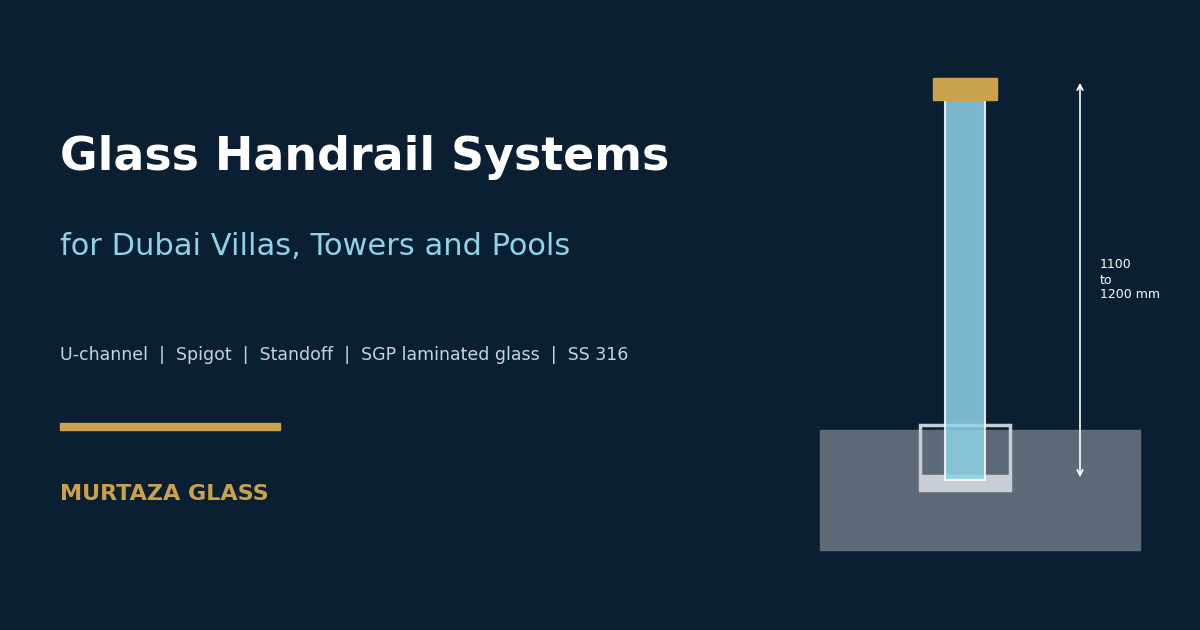
The right mounting system depends on the substrate, the exposure and the visual goal. Embedded U-channel suits frameless villa and penthouse balconies, spigots suit pool and deck perimeters, and standoff pins suit stairs and balconies where floor width is tight.
| Mounting System | Fixing Method | Ideal Application | Main Trade-Off |
|---|---|---|---|
| Embedded U-channel / base shoe | Continuous aluminium channel, grouted or wedged | Villa balconies, penthouse terraces, staircases | Needs slab-edge detailing and waterproofing planning |
| Stainless steel spigot / mini-post | SS 316 spigots at engineered intervals | Pool perimeters, garden decking, outdoor terraces | Loads concentrate at each clamp point |
| Standoff / pin-fixed | Side-mounted SS 316 pins through drilled glass | Staircase sides, balcony fascias | Hole position and edge distance are critical |
Substrate drives the shortlist. Cast-in channels need early coordination with the structural contractor, while core-drilled spigots can be added to an existing slab.
Exposure comes second. Pool-side and coastal terraces demand SS 316 throughout, while sheltered interior stairs can use a lighter specification. A seasoned glass handrail supplier will price both options so you can see the trade-off.
Tell your glass handrail supplier whether the slab is poured, post-tensioned or still at formwork stage. That single fact removes half the options and prevents expensive redesign.
Choose the system before the finish. A brushed gold cap rail on the wrong base fixing is still the wrong base fixing.
An embedded U-channel glass railing seats laminated glass in a continuous aluminium channel fixed to or cast into the slab edge, then locks it with wedges or grout. The channel carries the bending load, so the barrier shows no posts and the glass appears to float.
Two variants exist. A surface-fixed base shoe bolts to the slab top and suits refurbishment, while a recessed or cast-in channel suits new build where the floor finish can hide the profile. Both rely on the same principle: the glass is clamped, not clipped.
The classic edge-case failure is trapped water. If the channel cannot drain, moisture attacks the laminate edge and corrodes fixings from the inside. Drain slots cost almost nothing at design stage and a great deal to retrofit.
Do not notch or drill glass inside the base-shoe zone. Evaluation report ICC-ES ESR-3269 bars holes and notches in the lowest third of the glass height for the system it covers.

Choose stainless steel spigots or mini-posts when the barrier runs across pool decks, garden decking or terraces where a deep slab-edge channel is impractical. Each spigot clamps the glass at a point, so these systems rely on thicker laminated glass and precise anchorage.
Spigots are popular around pools because they are easy to inspect and replace. They also sit in chlorinated splash and salt air, so SS 316 grade, passivation and isolating gaskets matter.
Because loads concentrate at each clamp, spacing is not an aesthetic choice. Your engineer sets it from glass thickness, panel width and the pull-out capacity of the substrate.
Specify the spigot body, not just the finish. Round, square and flat-plate spigots grip glass differently, and each needs a matching clamp liner. Ask your glass handrail supplier for clamp torque values so installers tighten every fixing to the same figure.
Mini-posts add a short stainless post that clamps the glass above the deck. They suit raised timber decking where a core-drilled spigot cannot reach the structure.
Gaps between panels are part of the design. The engineer sets the joint width to absorb thermal movement and installation tolerance.
Scan the slab before core drilling. Cutting a post-tension tendon is a serious structural failure, and it is avoidable with a simple scan.
Standoff railings are worth it when floor width is limited and the barrier must fix to the side of a slab, stair stringer or wall. Stainless pins pass through drilled holes in the glass, so the balcony or stair keeps its full usable width.
That advantage carries a rule: hole position is structural. Holes sit a minimum distance from edges and corners, as set by the glass design, and they are drilled before toughening, never after.
Laminated SGP build-ups suit pin fixing because the stiffer interlayer limits deflection around the holes. Pin-fixed railings also need a robust substrate, because fixing into plaster or thin cladding fails fast.
Standoffs also change how glass is loaded. The pins grip a small area, so the glass is checked for local stress around each hole as well as for bending across the panel.
Plan hole templates carefully. A drilled panel cannot be rotated or reused, so one wrong dimension means a new panel, and a glass handrail supplier that surveys the site first protects you from that cost.
Pin caps come in several diameters and finishes. Satin finishes hide fingerprints better than mirror polish, which matters on a busy family balcony.

A fully frameless top edge gives the most minimal look, because the glass itself carries the line load. A slotted cap rail in stainless steel 316, matte black or brushed gold adds a continuous handhold and keeps panels aligned, at a small cost in minimalism.
Long straight runs need expansion joints, because metal expands under Dubai summer heat. Ask your glass handrail supplier where those joints sit before drawings are issued.
Finish durability varies. Ask your glass handrail supplier for coating data on UV and salt resistance before choosing black or gold.
A continuous cap rail also ties adjacent panels together, which gives installers a straight, aligned top line. The trade-off is one more component that needs finish protection and periodic cleaning.
Ergonomics matter too. On a glass staircase railing Dubai projects often need a graspable handrail for accessibility, and a frameless edge alone may not satisfy that brief. Confirm this with the architect early, before shop drawings begin.

Specify glass by load class, drop height and edge condition, not by thickness alone. Laminated toughened glass in 17.52 mm or 21.52 mm suits most elevated balconies, while 12 mm and 15 mm toughened panels belong to low-risk locations where the authority permits them.
| Build-Up | Typical Composition | Typical Use | Key Note |
|---|---|---|---|
| 12 mm toughened | Single toughened pane | Low-risk interior stairs, ground-level screens | Breaks into small pieces; no post-breakage retention |
| 15 mm toughened | Single toughened pane | Low-drop frameless or spigot use, engineer approved | Same breakage behaviour as 12 mm |
| 17.52 mm laminated | 8 + 8 mm with 1.52 mm interlayer | Villa balconies, terraces, staircases | Panel stays in the channel after breakage |
| 21.52 mm laminated | 10 + 10 mm with 1.52 mm interlayer | High-rise balconies, exposed or crowded areas | Preferred with SGP in tall towers |
Laminated glass holds together after breakage. A monolithic toughened panel shatters and leaves an open edge, which is unacceptable where the drop is a tower balcony. These build-ups are indicative, and your engineer confirms the final thickness from the project load case.
For exterior panels, specify heat-soaked toughened glass tested to EN 14179. Heat soaking reduces the risk of spontaneous breakage from nickel sulphide inclusions, which matters under Dubai solar loads.
Specify polished arrissed edges on every exposed side. Raw or ground edges chip easily and concentrate stress, so a quality glass handrail supplier polishes and inspects each edge before heat treatment.
SGP (SentryGlas) is stiffer and tougher than PVB, so laminated panels deflect less under wind and stay load-bearing after breakage. Kuraray reports that SentryGlas offers five times the tear strength and up to 100 times the stiffness of conventional PVB interlayers.
| Property | PVB Interlayer | SGP Interlayer |
|---|---|---|
| Stiffness | Softer; more deflection under load | Far stiffer (up to 100x, manufacturer figure) |
| Tear strength | Standard | About 5x PVB (manufacturer figure) |
| Edge moisture behaviour | Edge delamination risk if unprotected | More resistant to moisture and yellowing |
| After breakage | Holds fragments but sags | Keeps stiffness and stays upright longer |
| Cost | Lower | Higher; specialist laminator needed |
| Best fit | Sheltered interior stairs and balconies | High-rise, pool, exposed and frameless systems |
SGP costs more, and for a sheltered ground-floor interior stair PVB can be the pragmatic choice. The balance changes at height, and tower balconies usually justify the premium.
On frameless systems with no cap rail to hold a fractured panel, post-breakage stiffness is the safety margin that matters. That is why SGP is the default for high-rise glass balustrade work.
SGP also gives a clearer laminate edge. On a frameless run the edge is visible at every panel joint, so a water-clear edge looks cleaner than the yellow cast some PVB laminates develop in strong sun.

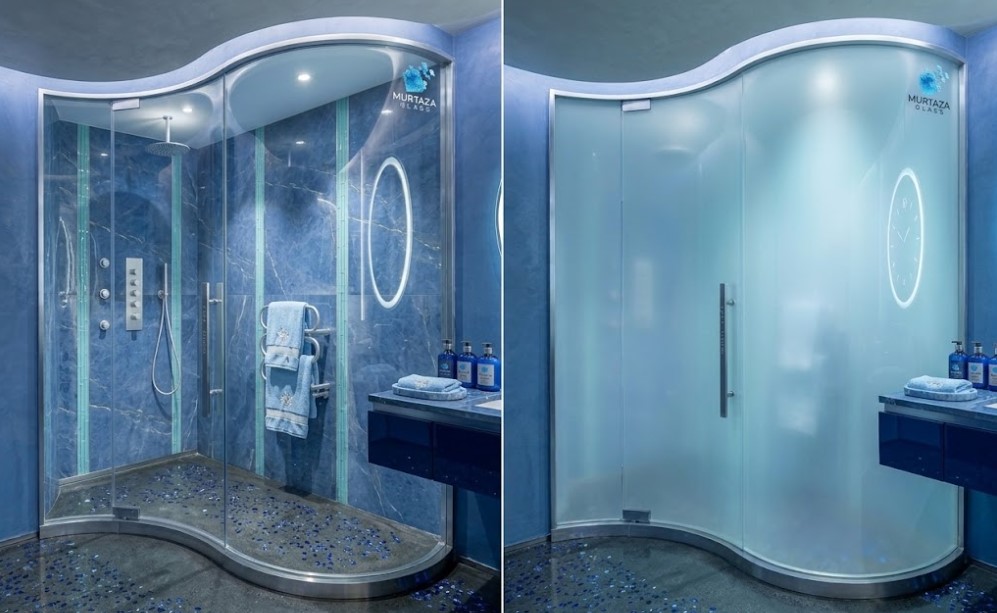
Choose extra-clear low-iron glass for a colourless edge and maximum view, and choose frosted, tinted or smart switchable glass when privacy or solar control drives the brief. Each option changes the laminate, so confirm the choice with your glass handrail supplier before ordering any glass.
Smart glass needs a power supply, a concealed cable path and sealed edges. Specify it early, because retrofitting wiring through a finished balustrade is rarely clean. Ask your glass handrail supplier to confirm the power rating of the film.
Etched and frosted surfaces also change cleaning routines, because they hold oils and fingerprints more readily than clear glass. Agree the cleaning method with your glass handrail supplier before handover.
Need a specification starting point? Review our frameless glass handrail system UAE service guide for mounting options, finishes and glass build-ups. Then send your drawings to our engineering team and get a load-checked recommendation from a glass handrail supplier that fabricates in-house.
Dubai projects follow the approving authority’s building code alongside the UAE Fire and Life Safety Code of Practice from Dubai Civil Defence. Requirements vary by authority and building type, so confirm the approved basis of design for height, line load, point load and glass type before ordering.
One published example is a Dubai Creative Clusters Authority circular. It requires guards where a space sits more than 760 mm above grade, sets balcony balustrades at no less than 1200 mm, and requires glass able to withstand 0.89 kN (90 kg) applied in any direction at any point.
Other jurisdictions, including those under Dubai Municipality and master-developer communities, can set their own values. Never assume one number applies citywide.
Treat the reference values as a starting point only. Your consultant’s basis of design governs, and our glass balustrade design guides explain how to read it.
Request the approval pack at tender stage, not after award. A complete glass handrail supplier submission includes calculations, material data sheets, shop drawings and test reports.

Wind pressure on a balcony glass panel rises with building height and peaks at corners and edges, where suction zones form. Engineers combine wind with the line load, then check the glass, fixings and slab edge for the worst case, not the average.
On a tower, a balustrade also acts as a sail. Panel width, height above the slab and open-corner exposure all increase bending at the base.
Ask your glass handrail supplier for a calculation package that shows wind inputs, glass stress, deflection limits and anchor pull-out checks. A drawing alone is not a structural submission.
Test evidence strengthens a submission. Ask whether the glass build-up and fixing have been load-tested or calculated to a recognised standard. A glass handrail supplier that can explain the method earns more trust than one quoting only a thickness.
Allow for gust deflection too. Panels should flex less than the limit set in the project specification.
Where exposure is severe, engineers may narrow the panels, thicken the laminate or add a cap rail to share load. Each choice changes cost, so settle it at design stage.
Wind also strengthens the case for laminated SGP. If a panel cracks under a gust, a stiff laminate stays in place until it is replaced.
Specify SS 316 stainless steel or marine-grade anodised aluminium for every exposed component, and isolate dissimilar metals. Gulf humidity and chloride deposits attack lower-grade 304 steel and thin coatings, so grade, finish and drainage decide how long the railing performs like new.
Pool areas add chlorine vapour on top of salt. Rinse routines and SS 316 grade become non-negotiable there. Ask your glass handrail supplier to state the rinse interval in the maintenance guide.
Tea staining, the brown surface bloom on stainless steel in coastal air, is cosmetic at first. Left uncleaned, it can progress to pitting. Regular fresh-water rinsing removes the salt film before it can bond to the surface.
Specify what the finish must survive. A stated salt-spray rating or a written coating warranty gives an objective basis for comparing every glass handrail supplier, while marine grade on its own is only a label.

Custom fabrication starts with a site survey, then moves through approved drawings, CNC cutting, edge polishing, heat treatment, lamination and installation. Murtaza Glass runs these stages as one chain, which removes the hand-off errors that appear when glass and hardware come from different vendors.
Toughened glass cannot be cut or drilled after heat treatment. That makes survey accuracy the biggest cost-saver on any project, because a 5 mm error found on site means remaking the panel.
Programme matters as well. Survey, approval, toughening and lamination run in sequence, so a late design change restarts the glass order. Lock the layout before the glass is released.
Commercial schemes add fit-out coordination for malls, offices and staircases. Murtaza Glass also fabricates glass partitions, so staircase screens and floor-level partitions can share one glass specification.

Glass handrails need light, regular maintenance: non-abrasive cleaning, a scheduled hardware check and a sealant inspection of every channel. We recommend inspecting fixings twice a year in coastal and pool locations, and replacing any chipped, cracked or delaminating panel immediately.
Sand is the quiet enemy in Dubai, because dry-wiping grit scratches glass. Rinse first, then wipe. A soft brush also clears loose sand from channels and clamp seats.
Keep a spare-parts list. Gaskets, clamp liners and setting blocks age faster than glass, and matching parts take time to source. Ask your glass handrail supplier for a recommended spares list at handover.
Document the baseline. Photograph each balustrade at handover so later inspections can spot movement, staining or edge changes quickly.
Inspect again after any storm or impact. More care routines are covered in our glass installation insights, and the same checklist works for every glass handrail supplier warranty.
Choose a glass handrail supplier in Dubai, UAE by verifying engineering evidence, not showroom samples. Ask for calculations, material certificates, a survey process and a documented installation method, then score suppliers on a weighted matrix so price is only one factor.
| Check | What to Ask Your Glass Handrail Supplier | Red Flag |
|---|---|---|
| 1. Engineering | Calculations for glass, fixings and anchors | Drawings with no calculations |
| 2. Glass quality | Interlayer type, heat-soak record, edge finish | Interlayer not named |
| 3. Hardware grade | SS 316 material certificates | “Stainless” with no grade |
| 4. Site survey | Measured data from site | Dimensions taken from drawings only |
| 5. Fabrication | Drilling and polishing before toughening | No control of hole positions |
| 6. Installation | Method statement and trained crews | Unknown sub-contractor |
| 7. Aftercare | Written maintenance guide and warranty terms | Verbal assurances only |
A custom, end-to-end supplier can cost more at tender than a trading-only quote. Over the life of the barrier it usually costs less, because one party owns the glass, the hardware and the fitting.
For villas, towers and commercial schemes, a glass handrail supplier Dubai UAE specifiers trust should show its working at every stage. Murtaza Glass fabricates and installs from its Sharjah base across Dubai and the GCC, and the glass handrail supplier page lists the available systems.
Planning a balcony, staircase or pool railing? Book a technical site survey with the Murtaza Glass engineering team and receive a load-checked specification before you commit. Call +971 58 543 0631 or email info@murtazaglass.com.
Buyers most often ask a glass handrail supplier about glass thickness, laminated versus toughened safety, and how hardware survives Gulf humidity. The three answers below give direct decision rules, which your structural engineer should confirm against the project’s approved basis of design before ordering.
Most elevated balcony railings in Dubai use 17.52 mm or 21.52 mm laminated toughened glass, with the final thickness set by the engineer’s load case, height and fixing type. High-rise and frameless systems typically use 21.52 mm glass with an SGP interlayer.
Laminated toughened glass is safer for elevated handrails because the interlayer holds broken pieces in place and keeps the barrier standing. Monolithic toughened glass breaks into small fragments, so it suits only low-risk locations where the approving authority allows it.
SS 316 stainless steel hardware and marine-grade anodised aluminium last longest in UAE coastal conditions because they resist chloride and humidity. Pair them with isolating gaskets, free drainage slots and regular fresh-water rinsing to prevent tea staining and galvanic corrosion.
October 28, 2026
October 22, 2026

October 14, 2026

October 12, 2026
September 30, 2026
 +971 58 543 0631

