
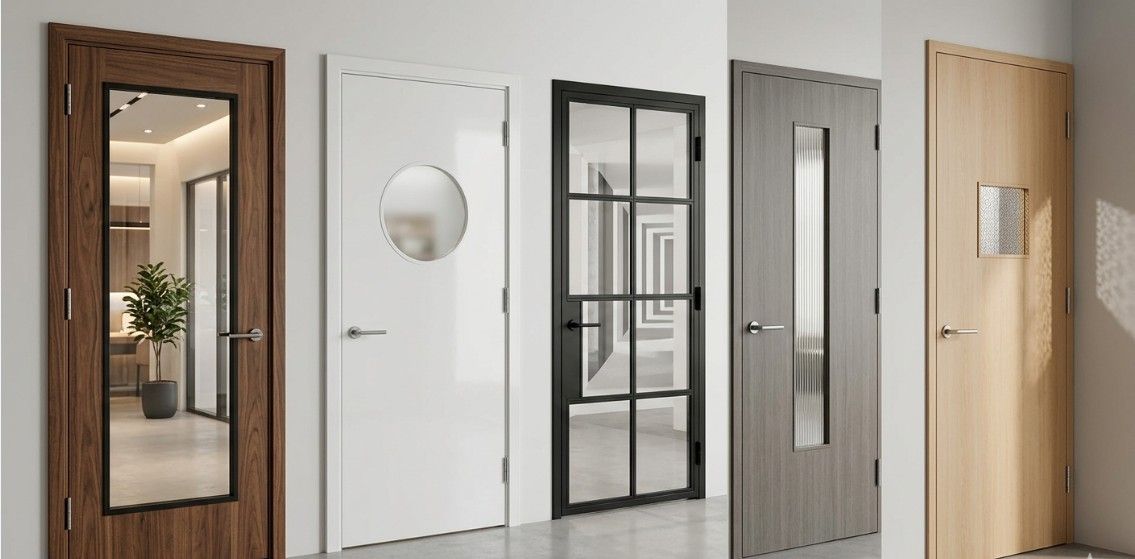
Vision panel glass is an important element in modern door systems. At its most basic, a vision panel is a window or glazed section installed within a door (or adjacent wall) that allows people to see through without opening the door itself. These panels enhance safety, aesthetics, and regulatory compliance in commercial, industrial, and residential settings. In fire-rated doors, vision panels are critical for maintaining both visibility and fire safety, meeting the same rating as the door itself.
The following detailed discussion explores purposeful door accessories such as vision panels, glazing types, technical specifications, applications, and data-driven industry insights.
A vision panel is an integrated glazed opening in a door that allows light transmission and visibility. Vision panels are often small windows placed at eye-level on a door. They help occupants see activity on the other side of the door without opening it, reducing collisions and improving situational awareness.
Understanding the purpose of vision panel glass requires a consideration of practical, safety, aesthetic, and regulatory factors. Key purposes include:
These multifunctional roles make vision panels purposeful door accessories rather than simple decorative features.
Vision panel glass selections depend on safety, visibility, privacy, thermal performance, and fire resistance requirements. The following are the major glass types used in door vision panels:
Tempered glass undergoes heat treatment and rapid cooling to significantly improve strength (~4× stronger than standard float glass). When it breaks it fragments into small, relatively blunt granules, reducing the risk of serious injury. These properties make it suitable for high‑traffic areas where safety and durability are priorities.
Key features
• Enhanced impact resistance compared with annealed glass.
• Breaks into non‑sharp pieces when shattered.
• Good for interior and exterior doors where visibility is needed without compromising safety.
Laminated glass consists of two or more glass layers bonded with an interlayer, normally polyvinyl butyral (PVB) or similar polymer. If broken, the interlayer holds fragments together, maintaining panel integrity and improving occupant safety.
Common uses
• High‑security doors.
• Areas requiring sound reduction.
• Locations where shared visibility and safety are both needed.
Double‑glazed units include two separated panes with an air or inert gas (arg‑on) filled space between them. This design increases thermal insulation and reduces noise transmission, making it effective for exterior doors where energy performance is a concern.
Benefits
• Improved thermal comfort and energy efficiency.
• Reduced outside noise.
• Can be combined with safety glass for enhanced performance.
Vision panel fire doors require glass that can withstand high temperatures and retard the spread of fire and smoke. Specialized fire‑resistant glass types are engineered to maintain structural integrity and, in many cases, insulation performance for rated durations (commonly 30 to 120 minutes). These include ceramic glass, wire‑reinforced glass, and specially interlayered laminated fire glass.
Fire‑rated specifications
• E rated glass (fire integrity only) prevents flame passage.
• EW rated glass limits heat radiation.
• EI rated glass provides full insulation and integrity for longer durations.
Obscured or frosted glass diffuses light and distorts vision, providing privacy while maintaining illumination. These surfaces can be achieved through acid etching, sandblasting, or surface texturing techniques.
Advantages
• Preserves natural light while blocking clear views.
• Adds aesthetic variation to door designs.
• Useful for privacy‑sensitive spaces such as washrooms and meeting rooms.
Wired glass contains an embedded mesh of metal wire during manufacturing. Historically used in fire applications, it can hold broken fragments together under heat exposure. However, modern codes in some regions have moved away from traditional wired glass due to concerns that the embedded wire can still allow shard formation upon impact.
Typical utilities
• Retrofit fire‑safety installations.
• Architectural aesthetics where visible wire pattern is acceptable.
• Locations prioritizing fire containment and basic visibility rather than high impact safety.
| Glass Type | Primary Purpose | Typical Applications |
|---|---|---|
| Tempered (Toughened) | Safety & impact resistance | High‑traffic interior doors |
| Laminated | Fragment restraint & security | Public buildings, high‑risk areas |
| Double‑Glazed | Thermal & acoustic insulation | Exterior doors, climate control zones |
| Fire‑Rated | Fire/smoke resistance | Fire doors, escape routes |
| Obscured/Frosted/Textured | Privacy with light | Restrooms, offices |
| Wired Glass | Fire resistance with mesh strengthening | Older code compliance, industrial zones |
Vision panels vary in features depending on their intended performance. Key features include:
For fire doors, glazed vision panels must provide both flame integrity and, in some cases, heat insulation to prevent excessive temperature rise on the non-fire side of the door. Glass types like ceramic or laminated fire-resistant glass help achieve this.
Vision panels should be impact safe to avoid shattering if struck, especially in high‑traffic areas. Many panels use tempered or laminated glass to meet these safety requirements.
In office, healthcare, and educational facilities, sound insulation and energy performance may be enhanced through double glazing or specialized glass assemblies.
Modern vision panels can be custom designed to suit door thicknesses, aesthetic preferences, and functional needs. Frames may be powder‑coated steel, aluminium, or timber depending on architectural specifications.
Vision panel glass is used across a wide range of sectors. Major applications include:
In hospitals, clinics, and laboratories, vision panels allow staff to monitor rooms and patients without opening doors, reducing contamination risks and improving workflow. Fire‑rated panels are often required in corridors and emergency paths.
Office buildings, schools, and public facilities use vision panels to enhance natural light and provide visibility in corridors, meeting rooms, and points of access. In fire doors on escape routes, vision panels help people see into potentially dangerous areas without exposing themselves.
Manufacturing plants and high‑risk production areas benefit from vision panels that help supervisors observe operations safely and quickly assess changes or hazards. Fire‑rated panels in these settings can enhance safety during emergency responses.
Retail environments use vision panel glass for aesthetic appeal, visibility into storage or staff‑only areas, and to enhance architectural transparency. Non‑fire‑rated glazed panels are common in storefront doors.
This blog covers Vision Panel Glass for Doors, detailing types, features, fire-rated options, applications, and expert insights for safety, aesthetics, and compliance in UAE and global settings.
A vision panel is a glazed section in a door that allows visibility without opening it, enhancing safety and monitoring. It is used in residential, commercial, and fire-rated doors.
Common types include tempered, laminated, double-glazed, fire-rated, frosted, and wired glass, each serving specific safety, privacy, or insulation needs.
Yes, fire-rated vision panels are tested to match the door’s fire rating, preventing flame and smoke spread while maintaining visibility.
They improve safety by preventing collisions, allow supervision, enhance natural light, and ensure compliance with building codes.
Vision panel glass is an essential component of modern door systems, combining safety, functionality, and aesthetics. From tempered and laminated glass to fire-rated and frosted options, each type serves specific needs in commercial, industrial, and residential applications. Proper selection and installation ensure compliance with building codes, enhance visibility, and improve overall safety.
For expert guidance on choosing, fitting, or maintaining certified vision panels and aluminium doors across the UAE, Murtaza Glass & Frames offers professional advice, high-quality materials, and skilled installation.
Contact our specialists to ensure your project achieves maximum safety, functionality, and visual appeal.
Discover professional guides on glass solutions, from doors and partitions to balustrades and windows, helping you choose the perfect style for your home or business.
September 8, 2026
September 1, 2026
August 25, 2026

August 18, 2026
August 11, 2026
 +971 58 543 0631
